Virtual panel discussion about art, performance, gender, and borders. We feature five artists who have participated in the Binational Arts Residency to hear their perspectives on the possibilities for intersectional feminist futures in the borderlands.
September 15th marks the beginning of Hispanic Heritage Month, in reality; Hispanic, Latinx, and Chicano/a history are much more than a simple month. W and Young Latino Professionals of Wichita (YLPW) are working together to have an engaging conversation about Latinx history with Dr. Michelle Tellez, Assistant Professor in the Department of Mexican-American Studies at the University of Arizona.
More info here: https://wyoungpros.com/event/more-than-a-month
Click here to watch the livestream.
Tucson friends - we are hoping to get your participation in this survey. I am the Tucson PI for the Arizona Youth Identity Project led by Dr. Nilda Flores-Gonzalez up at ASU - we need Tucson area folks to respond to this 15-minute survey. Please check it out and share widely, link here: http://bit.ly/3bFKDaq
In the summer of 2020, Sunhouse Arts (formerly Youth Collaboration of the Arts) created the largest living archive of today's Southwest, titled Work Project (ourworkproject.org).
In Work Project, over 200 individuals, including Presidential Medal of Honor recipient and Chicana activist Dolores Huerta, the Young People’s Poet Laureate Naomi Shihab Nye, former presidential candidate and Congressman Beto O'Rourke, and Food Network Emmy-nominated chef Aarón Sánchez have participated on this project.
Listen to my interview here.
To read more please visit Somos Escritoras.
Watch the informal conversation between Dr. HInojsa and Dr. Téllez where they discus cooking, history, music and Chicanx research!
To celebrate the fiftieth anniversary of Aztlán: A Journal of Chicano Studies, CSRC Press is making available to the public three essays from the Spring 2020 issue.
Essays in the issue explore the impact of affirmative action on the Chicano movement, the reinscription of La Llorona in works by Gloria Anzaldúa and Sandra Cisneros, symbolic networking among sonidos in Chicago's baile economy, and political opposition in the poetry of Javier Huerta.
In the dossier section, curated by Michelle Téllez, writers, poets, and artists reflect on fifty years of Chicana feminism.
This fiftieth anniversary issue also celebrates the work of LA-based artist Judithe Hernández, who created the covers and illustrations for the earliest issues of Aztlán. In the editor's commentary, Charlene Villaseñor Black looks at these works and discusses Hernández's vital role in shaping the journal. The cover and the artist's communiqué feature some of Hernández's recent works.
Learn more here.
Dr. Téllez was an invited Speaker to the “Gender, Labor, and Migration” Symposium hosted by the Center for Work and Democracy, School of Social Transformation at Arizona State University in Tempe, AZ.
#NWSA2019's first plenary: Centering Resistance, Animating Movements. Join Moya Bailey, Michelle Téllez, Lateefah Simon, and Noura Erakat as they discuss the feminist, queer, trans, economic, disability and racial justice warriors who have been at the forefront of movements for social change and how feminist engagements have animated and informed movements for transformation in local and transnational spaces. Find this on the conference schedule through here: http://bit.ly/nwsaconferenceprogram
From the award-winning writer of Your Healing is Killing Me, blu, The Panza Monologues and Barrio Stories, Virginia Grise returns to Tucson with a new play about the destruction and displacement of a Mexican-American community, roaming dogs, quarantines, earthmovers and ancient voladores: Their Dogs Came with Them. Adapted from the novel by Helena María Viramontes, the play ascribes new meanings to gang life dramas, gender queer identities, and Chicana/o/x coming of age barrio tales. Much like the structure of a freeway, the lives of four youth intersect and intertwine, unearthing stories about the effects and aftereffects of the Vietnam War, displacement, and state violence. Tucson, where the most diverse and densely populated neighborhoods were destroyed to create the Convention Center in the late 1960s, is an ideal site for a play that asks its community to consider how decisions around city planning and urban development impact everyone. Borderlands Theater, in collaboration with a todo dar productions, is producing this site-specific performance October 18-20, directed by Kendra Ware and aptly staged underneath the I-19 freeway in South Tucson.
Dr. Michelle Téllez will be playing Tranquilina and Grandmother Zumaya, read more about creative team here.
This transdisciplinary symposium, organized by the Center for Human Growth and Development (CHGD) and the Institute for Research on Women and Gender (IRWG), will focus on the growing tensions between mothers’ well-being and the increasing demands of child-rearing.
This event will further the scientific understanding of these tensions, recognize and explore how they appear in differential and discriminatory ways, and identify key knowledge gaps and opportunities in research that could inform practice, policy, and advocacy to promote the well-being of mothers, children and families.
More details see here.
Local authors and activists Naomi Ortiz (author of Sustaining Spirit: Self-Care for Social Justice) and Michelle Téllez (co-editor of The Chicana Motherwork Anthology: Porque sin madres no hay revolución) discuss how staying rooted in your culture helps women of color thrive and build resilience in activism, self-care and motherhood.
Moderator: Dominique Calza
Sunday, March 3 1-2pm (followed by book signing)
TACONAZO! with Mono Blanco
Son Jarocho Collective in Arizona
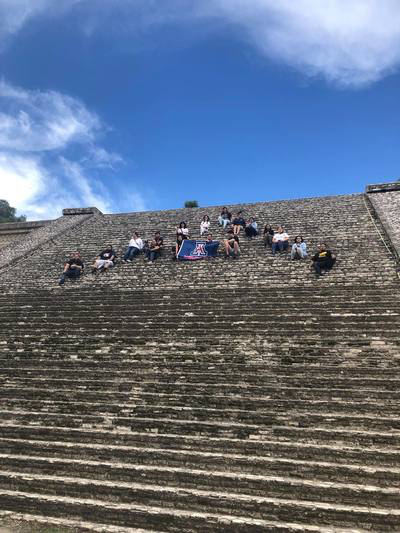
This summer Dr. Téllez spent 4-weeks as faculty lead for the Vivir Mexico Study Abroad Program through the Guerrero Center, the Department of Mexican American Studies and the Global Experiential Learning Program at the University of Arizona.
InterActions, the UCLA Journal of Education and Information Studies, and the Center for Critical Race Studies will host “Visions of Justice & Liberation: How Do We Get Free Through Education and Technological Practices?” on May 18, 9 a.m. – 5 p.m. at Campbell Hall, Rm. 1101. The symposium will include keynotes by Edxie Betts, a multiracial and trans artist, activist, and cultural producer, and Michelle Téllez, assistant professor of Mexican-American Studies at the University of Arizona.